

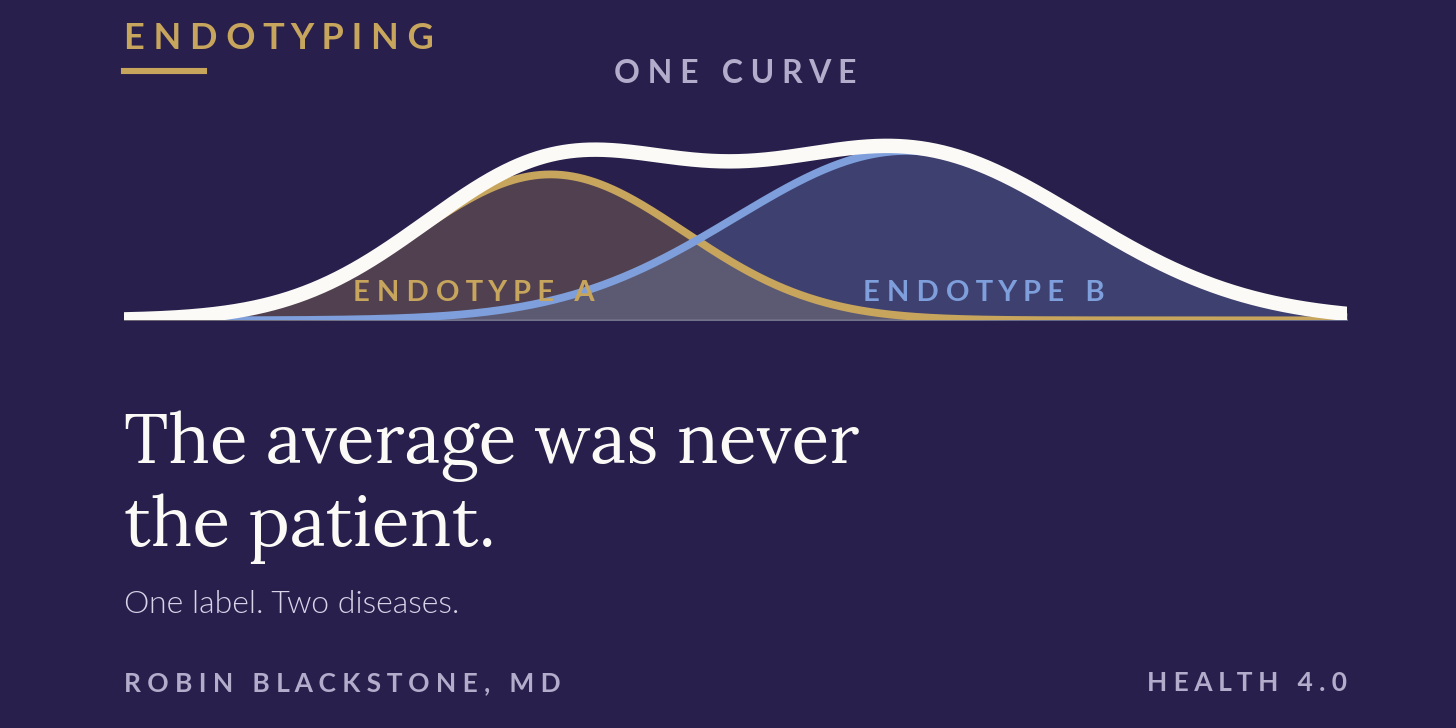
We talk about the heavy lifting culture and environment play in health outcomes. Today we go deep on that sliver of biology and something you may never have heard of: Endotyping, the idea that will decide whether precision medicine becomes real or stays a brochure.
I want to start with a drug that failed.
In the late 1990s, researchers built an antibody against interleukin-5. IL-5 is the signal that recruits and sustains eosinophils — the white blood cells found in enormous numbers in the airways of people with asthma. The pharmacology was elegant. Block the signal, lose the cells, relieve the disease.
They gave it to patients with asthma. Circulating eosinophil counts collapsed, exactly as engineered. And the patients were, clinically, about the same.
When a drug does precisely what it was designed to do and the patient does not improve, there are two possible conclusions. The target was wrong. Or the patient was wrong.
The field went with the first. Careful, serious people concluded that eosinophils were passengers rather than drivers — along for the ride, not steering. The program nearly died.
It was the second answer that mattered. The target, eosinophils, was right.
We had given it to the wrong patients.
The way that mistake got corrected is the most useful thing I know about chronic disease. And the fact that we are, right now, making the identical mistake with the most consequential drugs of my career is why I am writing this.
The word that does the work
Two terms, the whole argument lives in the space between them.
A phenotype is what a disease looks like from outside. Age of onset. What triggers it. How severe. Whether you also have eczema, or reflux, or allergies. Phenotypes are observational, and I do not want to be dismissive about them — a clinician who has seen ten thousand patients has real knowledge encoded in her pattern recognition.
An endotype is a subtype of disease defined by the mechanism actually driving it. Not what it looks like. What it is, at the level of a molecular pathway.
A phenotype tells you what to call something. An endotype tells you what mechanism to aim at if you want to impact it.
The truth is apparent. We “treated” phenotypes for much of the history of medicine. Almost every diagnosis I write down in a day was originally defined as a phenotype, because it was named before we had any way to see mechanism. Habits die hard.
Asthma is named after a sound, from the Greek for panting. Obesity is defined by a ratio of weight to height, using a formula developed in the 1830s by a Belgian mathematician who was studying populations rather than patients. Fatty liver was a shadow on an ultrasound. Heart failure is a description of what a person can no longer do.
We named diseases after their surfaces, because for most of medical history the surface was all we could reach. That part was honest. It was the limit of the available instruments.
The failure — and I include myself in it — is what we built on top of those names. We wrote guidelines for them. We created billing codes, and the codes became the operative reality, because the codes are what pays. We designed clinical trials around them, which means we tested drugs in populations defined by their outward appearance. We trained physicians to recognize them and treat them. And we told patients: this is what you have.
We enshrined the phenotype, me taught it to our patients and our colleagues. We billed by it.
Then, when the treatment for that name failed in a patient who carried that name, we did not question the name.
We questioned the patient.
Asthma: the proof
The people who did not give up on IL-5 asked a different question. Not who has asthma, but whose asthma is being driven by this pathway right now?
That turns out to be measurable, and cheaply. Eosinophils in the blood. Eosinophils in sputum. Nitric oxide in exhaled breath. IgE. A history of frequent exacerbations.
So the trials were run again, restricted to patients with evidence of active eosinophilic inflammation. The same class of molecule cut exacerbations by roughly half. It let people taper off oral steroids they had been taking for years — with everything chronic glucocorticoids do to bone, glucose, mood, and face.
Nothing about the drug changed. The definition of the patient changed.
That experience reorganized severe asthma into something closer to actual disease biology. Today the field splits it, roughly, into two. Type-2 high is the IL-4, IL-5 and IL-13 axis — eosinophilic, allergic-inflammatory, measurable in blood and breath. It is somewhere around half of severe asthma, and it now has a whole shelf of targeted biologics aimed at different points in that pathway, including one that works upstream at the alarmin level and reaches somewhat further than the rest.
The other half is type-2 low: neutrophilic, or paucigranulocytic, or obesity-associated, or smoking-related, and some of it not primarily inflammatory at all. It remains comparatively underserved, and the honest reason is that we understand its mechanisms less well. There is no clean biomarker and no clean target yet.
But consider what happened to those type-2 low patients in all the years before we knew to draw this line.
She arrives on maximal inhaled therapy, still symptomatic. So we escalate. We add oral steroids and hand her the metabolic consequences. We review her inhaler technique. Again. We note in the chart that adherence may be contributing. We may use the word compliance, which has an entire negative worldview inside it.
She was on the wrong drug. Not the wrong dose of the right drug — the wrong drug, for a mechanism it does not touch. Her body was behaving exactly as its biology dictated. The failure was ours: a mechanistic hypothesis held with unearned confidence.
And our explanation for our own failure was her character.
That is not a story about asthma. Asthma is simply where we caught the pattern first, because the biomarkers were cheap and the pathway was clean. That pattern is the default operating mode of twentieth-century chronic disease care, and it is still running in most clinics today.
GLP-1: the drug without the endotype
I have spent my career in metabolic and bariatric medicine, and I did not expect to see anything like the last five years.
The incretin-based therapies are the most consequential pharmacology of my professional life. Semaglutide produces roughly 15% total body weight reduction. Tirzepatide, in its pivotal obesity trial, roughly 21% — territory we previously reached only with surgery. And in people with obesity and established cardiovascular disease but without diabetes, semaglutide reduced major adverse cardiovascular events by about 20%. That last result should have ended an argument I have been having for thirty years. You cannot look at obesity and still call this a lifestyle problem. We are preventing deaths.
Here is how we prescribe them.
Start low. Titrate up. Push to the highest tolerated dose. If it isn’t working, switch to the other one. If that fails too, the patient is a non-responder. And if it does work — once she reaches her “goal” weight, her insurance often stops paying for the drug that got her there, as though the disease were cured rather than treated.
That is the algorithm. There is no mechanism in it anywhere.
Fifteen percent is an average, and an average is a fact about a population, not a prediction about a person. Inside those trial distributions are people who lost a third of their body weight and people who lost almost nothing at full therapeutic dose. Something real distinguishes them. We cannot currently tell them apart in advance. We find out by trying, over months, at extraordinary cost.
And the heterogeneity is not hiding. It is visible to me in clinic every week.
There is the patient whose satiety signal never seems to arrive — not psychological hunger, neurological; the message that she has eaten is not being delivered. There is the patient with abnormally rapid gastric emptying, full for twenty minutes. There is the patient who eats to regulate emotion, whose appetite biology may be close to normal and whose problem is not appetite at all. There is the patient with a genuinely low resting energy expenditure, eating no more than her neighbor and gaining anyway.
Serious work, much of it out of Mayo, has begun formalizing patterns like these into measurable categories with differential drug response. That is exactly the right direction of travel. But notice what it still is: phenotyping. Observable patterns. We are in obesity medicine roughly where asthma was in the 1990s. We have the drugs before we have the endotypes.
Now add the economics, because this is where it stops being academic.
These drugs are expensive and supply has been constrained, so access is being rationed with the crudest instrument available: BMI thresholds, prior authorization, step therapy, employers dropping coverage mid-year.
A BMI threshold is a phenotype, and a bad one. It is a ratio of mass to height. It says nothing about mechanism, nothing about who will respond, nothing about whose organs are actually failing.
So look at the position we have engineered. A class of drugs that transforms some lives and barely moves others. No way to know which in advance. A price that forces rationing. And a rationing method that is biologically illiterate. Then we act surprised when patients conclude the whole enterprise is a racket, and when payers conclude the same.
Here is the way out, and it is the pivot of this entire essay.
If we could identify in advance the woman who will lose 25% and the woman who will lose 4%, we would not be rationing anymore. We would be targeting.
Those are categorically different acts. Rationing means withholding something that works from someone who needs it, on the basis of cost. Targeting means directing a mechanism-specific therapy at the mechanism it addresses, and offering the other patient something that actually fits her biology.
To be plain, because this argument gets borrowed by people who want the opposite: targeting is not a case for spending less on obesity. It is a case for spending the same money accurately instead of blindly.
The first destroys trust and generates litigation and legislation. The second is simply good medicine. And it happens to cost less.
MASH: what it looks like when they arrive together
For most of my career, “fatty liver” was a shrug on a radiology report. An incidental note on an abdominal ultrasound. Lose some weight, follow up in a year.
Here is what that shrug was hiding. Under those three words sat two completely different fates. For most people, liver fat that would never harm them. For a minority, a progressive fibrotic disease heading toward cirrhosis and hepatocellular carcinoma. One label. Two prognoses. No way to sort them — and therefore, conveniently, no urgency about sorting.
Then the field did three disciplined things in quick succession.
First, it renamed the disease around its mechanism. Nonalcoholic fatty liver disease became metabolic dysfunction-associated steatotic liver disease. Nonalcoholic steatohepatitis became MASH.
That looks like nomenclature politics. It is not. Look at the old name: nonalcoholic. The disease was defined by what it was not. That is a diagnosis of exclusion wearing the costume of an entity. The new name defines it by the metabolic dysfunction actually driving it — and you cannot endotype a disease that is named after an absence.
Second, it identified the population that actually progresses. MASH with moderate-to-advanced fibrosis, stage F2 to F3. Not the amount of liver fat. Not BMI. Not transaminases. Scar tissue. Fibrosis stage turned out to be the dominant predictor of liver-related death.
Third — and this is what made it real — that group became findable without a biopsy. Staging fibrosis used to require putting a needle into someone’s liver, which is precisely why almost nobody was staged. Now FIB-4 calculates from labs most patients already have, and elastography measures stiffness in minutes. An endotype that nobody could identify at scale became one you can find in an ordinary clinic.
And then the drugs arrived, approved for that group specifically.
Resmetirom, in March 2024: a thyroid hormone receptor-beta agonist acting inside the hepatocyte, indicated for noncirrhotic MASH with moderate-to-advanced fibrosis. In its pivotal trial roughly a quarter to a third of treated patients achieved MASH resolution, and a comparable share achieved fibrosis improvement, against markedly lower rates on placebo.
Then semaglutide, in August 2025: the same fibrosis stages, an entirely different mechanism, coming at the liver through systemic metabolic disease. Europe is moving in the same direction, with a positive regulatory opinion in early 2026.
Let me be honest about the effect sizes. They are not miraculous. I would rather say that than oversell.
The point is not the effect size. The point is the architecture. Developed for an endotype, tested in an endotype, approved for an endotype — and the endotype identifiable non-invasively. A treatable population carved out of an untreatable label.
Which produces the question that will define the next decade of chronic disease practice: two mechanisms, one endotype — which patient gets which, or both, and in what order?
Notice that this question could not have been asked five years ago. You cannot ask it about “fatty liver.” There is no version of that conversation that begins with a shadow on an ultrasound. You can only ask it once the label has been cut into mechanisms.
One more thing before I move on.
Everything I have said so far treats mechanism as though it were intrinsic — as though an endotype were something a patient simply has, like eye colour. Most of it is not. The T2-low asthma endotype, the one with no targeted biologic, is also the one most associated with traffic pollution and housing stock. Which means the patients we cannot treat and the patients we have failed to protect are substantially the same people.
There is a name for the other half of this. The exposome — the sum of what a person has been exposed to across a lifetime, proposed as the complement to the genome. A genome is a fixed input. An exposome is a trajectory. And almost none of it appears anywhere in the medical record.
Why we didn’t do this sooner
The comfortable explanation is that the science was not ready. That is partly true and mostly an alibi.
The harder explanation is that endotyping exceeds the cognitive capacity of the clinical encounter we built the system around.
Consider what defining and applying an endotype actually requires. Multiple biomarkers interpreted jointly rather than sequentially. Imaging quantified rather than described in prose. Genetic, and increasingly proteomic and metabolomic, data. The longitudinal trajectory — not this eosinophil count, but the pattern over three years. Response to prior therapy, fed back as evidence about mechanism. And then all of it integrated into a probabilistic judgment about which mechanism is driving this person’s disease, at the moment a decision must be made.
No physician can do that in fifteen minutes. I cannot do it, and I have spent decades in a subspecialty built on precisely this kind of metabolic reasoning. The human mind holds a handful of variables in genuine simultaneous consideration. Endotyping routinely requires dozens, weighted, with interactions.
So we did what any overloaded system does. We simplified until the task fit the resource. Diseases became labels. Labels became guidelines. Guidelines became algorithms. Algorithms became defaults. We built quality metrics that reward applying the default to the label, called the result standard of care, and told ourselves the variation left over was noise, or non-adherence, or social determinants.
This is why I resist framing artificial intelligence in medicine as a productivity story. Ambient documentation is useful. Inbox drafting is useful. Neither is the point.
The point is that computational integration of high-dimensional patient data is the only known mechanism by which endotype-level precision becomes deliverable to a population rather than available to a research cohort. Precision medicine has been promised for twenty-five years and remains, for most patients, a brochure — not because we lacked conviction, but because the cognitive infrastructure to deliver it did not exist.
It exists now. And that changes the moral situation. When precision was impossible, treating everyone with the same label the same way was reasonable practice.
Now it is a choice.
The trust argument
I care about this because of what imprecision has done to the relationship between people and medicine.
Ask why trust has collapsed and the answers reach for something big and recent. A scandal. A pandemic. Politics. Social media. I think it is smaller than that, and much more our own doing.
Consider what the non-responder experiences. She is told she has a disease. She is told there is a treatment. She takes it exactly as prescribed, often at real cost and real side-effect burden. It does not work.
And then the system’s explanation for its own failure is her.
She must not be taking it correctly. She must be eating more than she reports. She must not want it enough.
We have said versions of this to asthma patients for decades and to patients with obesity for a century — and we said it while being wrong about the mechanism of their disease.
Multiply that by millions of encounters, across generations, and you do not have a communications problem. You have several million people with direct personal evidence that an institution claiming to understand their bodies did not.
Precision is the repair. Not because accuracy is elegant, but because “that treatment didn’t work because your disease runs on a different mechanism, and here is the one that targets yours” is a fundamentally different human event than “you must not be trying.”
The first is a physician using knowledge on a patient’s behalf. The second is an institution protecting itself.
Trust is not rebuilt with messaging strategy. It is rebuilt by being right more often, and by having an honest account of the times we are not.
Unthinkable — Debatable — Obvious
I think in terms of the Overton Window — the range of positions a society treats as reasonable to hold in public. Policy does not change because an argument is proven. It changes when a position moves from unthinkable to debatable to obvious.
So the practical question for anyone trying to change a health system is: which sentences need to move? Here are five. Every one is defensible today with evidence already in hand. Not one is consensus.
A diagnosis is a hypothesis, not a fact. Today this sounds like an attack on medical authority. It is the opposite. A physician who treats a diagnosis as a hypothesis to be tested is doing more rigorous work than one who treats it as an answer.
Coverage decisions made on labels rather than mechanisms are medically indefensible. Right now a BMI cutoff or a diagnostic code determining access to therapy is treated as ordinary administration. It should be as unacceptable as prescribing a biologic without checking the biomarker. Payers are not the villains here; they are using the only instrument the clinical world handed them. When we produce endotypes, we remove that excuse — from them and from ourselves.
Treatment failure is evidence about the disease, not about the patient. This is the highest-yield, most important sentence on the list, because it converts a moral judgment into a scientific observation. Non-response is data. It tells you your mechanistic hypothesis was wrong. In a properly designed system, every failed treatment would update the model rather than sully the patient’s reputation.
Delivering precision at population scale requires computational capacity beyond human cognition — and using it is a professional obligation, not a threat to the profession. This is the hardest one, because it asks physicians to accept there is a limitation on our own ability to reason. But no one thinks less of a cardiologist for using an echocardiogram instead of an ear. The instrument extended the sense. Intelligence is an instrument that extends judgment.
Care, payment and research should be organized around mechanisms rather than organ-based specialties and diagnostic labels. The eosinophilic endotype crosses asthma, chronic rhinosinusitis with nasal polyps, eosinophilic esophagitis and atopic dermatitis. Four specialties, four clinics, four prior authorizations, one mechanism, sometimes one drug. Our organizational chart is an artifact of nineteenth-century anatomy. Biology does not respect it.
Health 4.0
If Health 1.0 was the physician’s senses, 2.0 the laboratory and the hospital, and 3.0 the digitized, protocol-driven, industrialized system we are currently drowning in — then 4.0 is not more digitization. It is the point at which the system’s unit of analysis stops being the label and becomes the mechanism, and the person.
Practically, that system looks like this. Diagnosis becomes probabilistic and provisional: a stated hypothesis, with a confidence, and a plan to test it. Biomarkers, imaging and molecular data are integrated computationally at the point of decision rather than filed as documents. Therapy is selected against mechanism, with predicted response stated up front so that both physician and patient know what is being tested. Response is measured and fed back, so non-response revises the model. Payment follows mechanism-matched appropriateness rather than label-based eligibility. And research runs continuously inside care, because every treated patient with a characterized endotype is an observation.
That system is cheaper than the one we have. It is also kinder — which is not a coincidence, because most of what is expensive in health care is the cost of being wrong repeatedly and slowly.
None of this is speculative. Every component exists somewhere today. Severe asthma clinics run on this logic. Oncology has run on it for two decades and nobody calls it futuristic; they call it standard. MASH just did it, in public, in under two years.
What does not exist is the decision to build the whole system this way — for chronic disease, for everyone — and the honesty to admit that until we do, we are practicing a medicine that systematically mistakes its own limitations for the patient’s failings.
That interleukin-5 antibody was never a failed drug. It was a working drug, given to a population defined by a sound the lungs make.
We have thousands of drugs like that. And millions of patients being told, right now, that a treatment should have worked for them.
The instruments finally exist. What is missing is the willingness to say plainly that a diagnosis was never the answer — only the beginning of the question.
Next week: the other half of the mechanism. Environment does not sit beside biology — it becomes biology, and it stays. Three patients, three exposures, three endotypes. Including a question I have been avoiding: whether the MASH endotype I just finished celebrating is itself two different diseases.
The full architecture — evidence, governance, and what it would take to build — is in Doctor AI: Reimagining Healthcare, Rebuilding Trust, Delivering Health 4.0.
robinblackstone.com
Notes and sources
Anti-IL-5 in unselected versus eosinophilic asthma. Early negative trials in unselected populations (Flood-Page et al., AJRCCM, 2007) versus subsequent biomarker-selected trials: DREAM (Lancet, 2012) and MENSA (NEJM, 2014).
Tezepelumab and the type-2 low population. NAVIGATOR (NEJM, 2021); approved December 2021.
Semaglutide 2.4 mg in obesity. STEP 1 (NEJM, 2021): −14.9% mean body weight at 68 weeks.
Tirzepatide in obesity. SURMOUNT-1 (NEJM, 2022): −20.9% at 72 weeks on 15 mg.
Cardiovascular outcomes. SELECT (NEJM, 2023): 20% relative reduction in MACE (HR 0.80) in patients with overweight or obesity and established cardiovascular disease, without diabetes.
Obesity phenotypes. Acosta and colleagues, Mayo Clinic — phenotype-guided pharmacotherapy in obesity.
MASLD/MASH nomenclature. Multi-society Delphi consensus, June 2023.
Resmetirom. FDA accelerated approval, March 2024, for noncirrhotic MASH with moderate-to-advanced fibrosis (F2–F3). MAESTRO-NASH (NEJM, 2024).
Semaglutide in MASH. FDA approval, 15 August 2025, for noncirrhotic MASH with moderate-to-advanced fibrosis (F2–F3). CHMP positive opinion for conditional marketing authorisation in the EU, January 2026.
A note on numbers: effect sizes are stated as ranges or approximations throughout, because the precise figure depends on dose, duration and endpoint definition. Where I have rounded, I have rounded conservatively.