

From metabolic surgery to histotripsy, medicine is moving from managing consequences to making precise, mechanism-level interventions. Our health system has not caught up.
By Robin P. Blackstone, MD, FACS

The new pattern of medicine: precision at the mechanism, not endless rescue downstream.
Recently, a patient with a liver tumor lay still on a table while a focused beam of sound destroyed the tumor from outside the body.
No incision. No treatment needle. No radiation.
The technology is called histotripsy. It uses focused ultrasound to create microscopic bubble clouds that mechanically break down targeted tissue. One recent patient was home and back to normal activities the same evening. The FDA authorized the Edison system in 2023 for the noninvasive destruction of liver tumors; more than a thousand people have since undergone liver-tumor procedures with the system, and in May its manufacturer submitted a request to expand the indication to kidney tumors.
Long-term cancer outcomes are still being studied. That matters. But so does the shape of the advance: a treatment that once required entering the body can now, for selected patients, be delivered from outside it.
I have spent my career as a metabolic and bariatric surgeon, and I want to tell you that this story is not really about a machine.
It is about a pattern.
Once you see it, you cannot unsee it.
The knot
In 2019, in the Bulletin of the American College of Surgeons article “Surgery and the Gordian Knot of Metabolic Syndrome”, my coauthors and I described metabolic syndrome using an image from antiquity: the Gordian knot.
Obesity, type 2 diabetes, hypertension, dyslipidemia, fatty liver disease, polycystic ovary syndrome and some cancers have been divided into separate specialties, separate appointments, separate drugs and separate payment streams. Medicine spent a century trying to untie the knot one strand at a time—managing each consequence after it appeared, often for the remainder of a patient’s life.
Our argument was that these were not simply independent failures occurring in the same body. They were often connected manifestations of a shared metabolic pathology. A decisive intervention at the mechanism could change several strands at once.
Metabolic surgery had already demonstrated the principle. In one long-term prospective study, Roux-en-Y gastric bypass produced durable weight loss and type 2 diabetes remission in approximately half of affected patients at twelve years. Surgery did not merely make the stomach smaller. It changed metabolic signaling, appetite regulation and the body’s defense of weight.
But the country was not ready to hear what the biology was saying.
Surgery was called extreme. Obesity was still treated as a failure of discipline. Patients were told, in one form or another, that the knot was their fault.
Then the GLP-1 drugs arrived, and something changed that had never changed before.
The number that had never moved
In July 2026, Gallup reported that its measure of U.S. adult obesity had fallen from a peak of 39.9% in 2022 to 36.4% in 2026, while the share of adults reporting current GLP-1 use for weight loss rose from 3% in 2024 to 11%.
These are self-reported survey data, not measured national examination data, and parallel trends alone cannot prove that the drugs caused the entire decline. But Gallup has used the same method over time, and the direction is statistically meaningful. After decades in which the curve seemed capable of moving in only one direction, it moved the other way.
No lecture about personal responsibility accomplished that.
A class of molecules helped make it possible.
The drugs did not solve the biology. They solved the politics.
Metabolic surgery had demonstrated the biology decades earlier. The drugs made that biology culturally legible. A weekly injection made it finally sayable, at scale, that obesity is a chronic biological disease—not a referendum on character.
That was a therapeutic breakthrough. It was also a political one.
The pattern is bigger than obesity
The obesity story is the loudest instance of something happening across medicine.
Look at the shape of it.
In liver tumors, focused sound can destroy targeted tissue without an incision. Kidney tumors may be next.
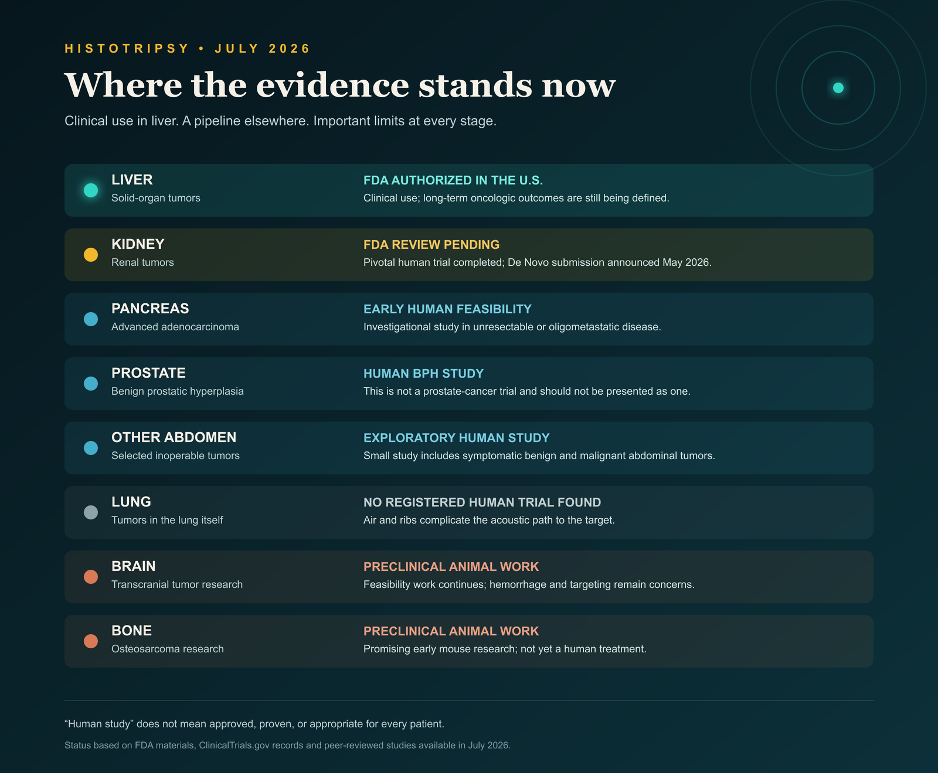
Histotripsy status as of July 2026. A human study does not mean that a treatment is approved, proven or appropriate for every patient. Prostate work shown here is for benign prostatic hyperplasia—not prostate cancer.
In severe aortic stenosis, a new valve can be delivered through a catheter rather than through an open chest. In selected patients, randomized trials have found comparable major outcomes between transcatheter and surgical valve replacement through five and six years, even as questions of lifetime durability and reintervention remain.
In some advanced cancers, immunotherapy has produced durable survival—and, for a subset of patients, something approaching long-term disease control—where survival was once measured in months. For some patients, managing cancer as a chronic disease is now current therapy. Preventing more cancers from developing at all—and intercepting others before they become clinically apparent—is the horizon we can already see.
In hepatitis C, eight to twelve weeks of oral medication now cures more than 95% of patients, where medicine once waited for cirrhosis, liver cancer or transplantation.
Different organs. Different specialties. Different technologies.
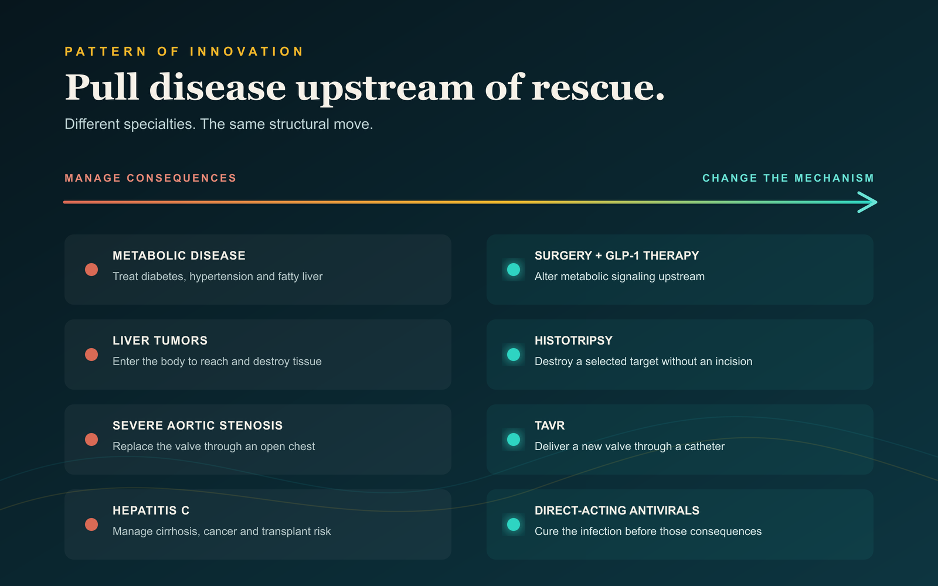
The technologies differ. The structural move is the same: pull disease upstream of rescue.
The same move: pull disease upstream of rescue. Stop paying forever for the consequences when a precise intervention can alter the mechanism.
Stop untangling the knot.
Cut it.
The honest part
None of this is free, and I will not pretend otherwise.
My own field sometimes dismisses the medications by saying that when patients stop taking them, weight often returns. That is true. But surgery is forever too—and so is a surgical complication.
Stopping a drug is a decision a patient may be able to revisit next month. A stricture, leak, nutritional injury or chronic complication may not be reversible.
Medication carries its own risks, costs and uncertainties. Metabolic surgery has unmatched durability for many patients and a long evidence base, but it also asks the patient to accept an irreversible intervention. When timing is crucial or disease severity demands a decisive intervention, surgery may be the first option. In most other cases, it should follow a fair trial of medication and comprehensive nonsurgical care—fairly offered, adequately supported and not declared a failure simply because coverage ran out.
Histotripsy is genuinely noninvasive, but it is new, not appropriate for every tumor, and its long-term oncologic role is still being defined. TAVR avoids a sternotomy, but age, anatomy, valve durability and future procedures still matter.
Every advance carries a ledger of risk, benefit, durability and reversibility.
The honest clinician puts both columns on the table. Then the patient, the evidence and the biology choose together. The Human Principal—the person whose life and health are at stake—carries both the authority and the responsibility for the decision.
That honesty is not a brake on innovation. It is what earns the trust innovation requires.
Why this is a systems story
When a decisive, less-invasive treatment exists but patients cannot reach it, the remaining barrier is often no longer scientific.
It is architectural.
We built a health system that pays, in perpetuity, for the consequences of disease: insulin, dialysis, repeat admissions, complications and rescue. At the same time, it places interventions that may prevent those consequences behind coverage cliffs, prior-authorization mazes, fragmented benefits and geographic treatment deserts.
That arrangement made a grim kind of sense when decisive options did not exist.
Increasingly, they do.
Keeping the old payment and delivery architecture in place is now a choice—and an expensive one.
This is the heart of what I mean by Health 4.0: a system organized around prevention, early detection and durable treatment at the level of mechanism, delivered through the precise intervention that fits the person. Sometimes that intervention will be behavioral. Sometimes pharmacologic. Sometimes surgical. Sometimes it will be a beam of sound delivered from outside the body.
The point is not that one tool wins.
The point is that the system must stop forcing every patient through the same door.
Cutting the Knot
This essay begins a series.
In Cutting the Knot, I will take the metabolic knot apart strand by strand: type 2 diabetes, hypertension, dyslipidemia, fatty liver disease, PCOS and obesity-associated cancer. I will place the surgical and pharmacologic evidence side by side, including what works, what fails, what lasts, what reverses and what we still do not know.
This is not an argument for surgery over medication, or medication over surgery.
It is an argument against making patients wait for rescue because the system is more comfortable paying for consequences than changing mechanisms.
Alexander understood something medicine forgot for a century: some knots are not meant to be patiently untied.
They are meant to be cut.
Across medicine, we have finally begun to build the swords.
The question now is whether we will build a system with the courage—and the honesty—to use them.
Where are you seeing this shift in your own field? What disease are we still managing strand by strand when we should be changing the mechanism? I would like to hear the examples I am missing.
Sources and further reading
In 2019, in the Bulletin of the American College of Surgeons article, “Surgery and the Gordian Knot of Metabolic Syndrome”my coauthors and I described metabolic syndrome through an image from antiquity: the Gordian knot.
• Surgery and the Gordian Knot of Metabolic Syndrome
• Mercy patient experience with histotripsy
• FDA De Novo classification of the Edison System
• Focused Ultrasound Foundation: more than 1,000 liver-tumor patients treated
• HistoSonics kidney-tumor FDA submission
• Pancreatic-tumor histotripsy feasibility study
• Prostate BPH histotripsy study
• Exploratory abdominal-tumor histotripsy study
• Technical review of histotripsy and acoustic access
• Preclinical transcranial histotripsy tumor study
• Preclinical histotripsy osteosarcoma study
• Twelve-year outcomes after gastric bypass
• Gallup: 2026 GLP-1 use and obesity trend
• Five-year outcomes of TAVR versus surgery
• Six-year outcomes of TAVR versus surgery
• National Cancer Institute: durable immunotherapy responses in a subset of advanced cancers
• CDC: hepatitis C treatment and cure
For more information about Health 4.0 - a novel health system for the 21st Century go to https://robinblackstone.com