
Before Rescue: What a Gallbladder Operation Reveals About the Future of Health
The real question about autonomous surgery isn't whether a robot can cut. It's whether it knows when not to.

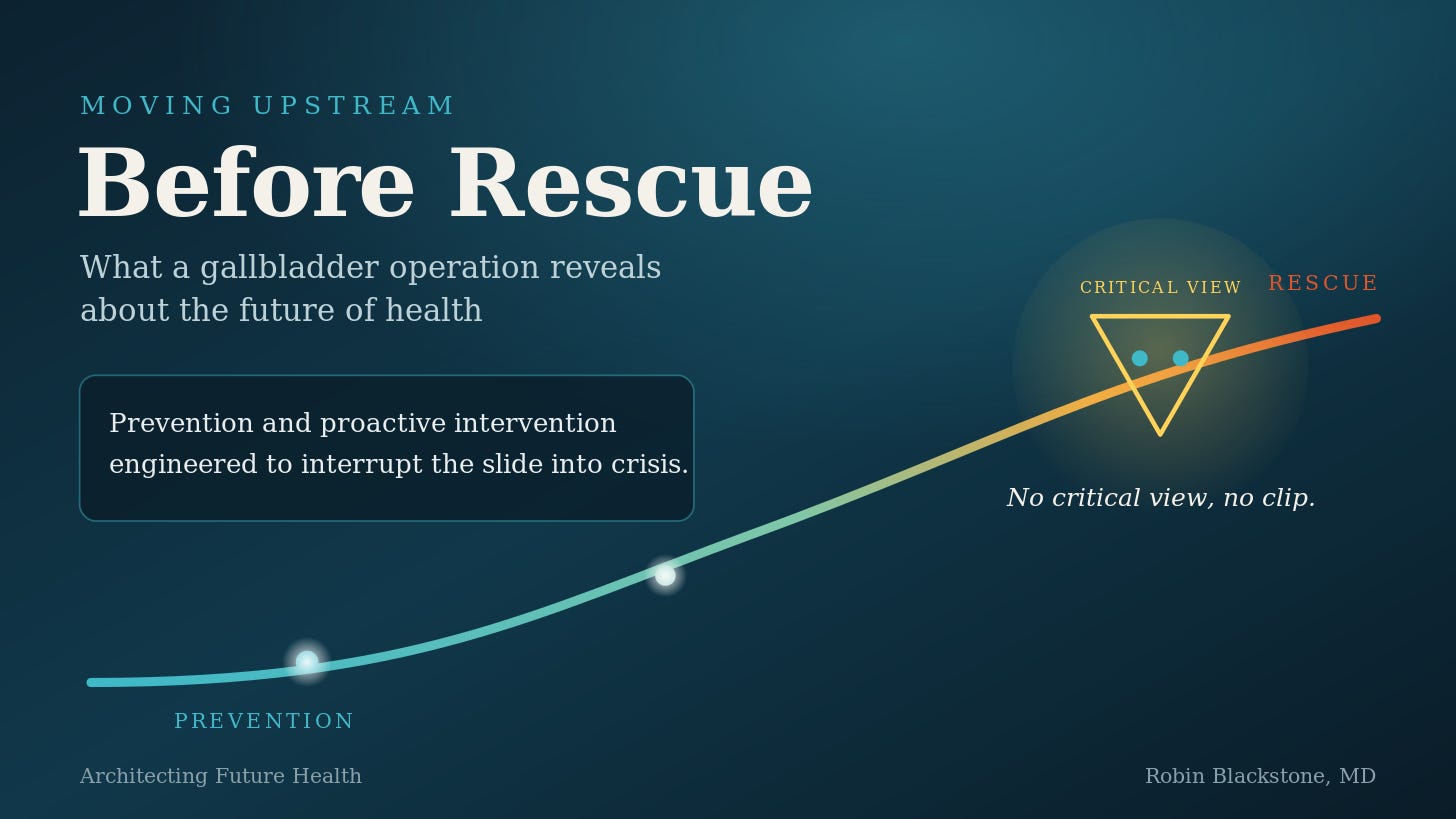
There is a line in medicine we do not talk about enough.
On one side of that line is Rescue. The operating room. The ICU. The transplant list. The catheterization lab. The heroic intervention after disease has advanced, anatomy has changed, organs have failed, or risk has finally declared itself.
Modern medicine is very good at Rescue. We have built entire institutions around it. We celebrate it, fund it, train for it, measure it, and tell stories about it. And we should. Rescue saves lives.
But the future of health will increasingly be defined by what happens before Rescue is necessary — by preventing the disease that would demand it, and by preventing harm within the procedures we cannot avoid.
That is the pulse of the next era of medicine. Not less expertise — earlier expertise. Not less technology — better-timed technology. Not the abandonment of Rescue — the redesign of health so fewer people arrive there.
It is the deeper pattern behind some of the most important changes now emerging in medicine. They may look unrelated at first: GLP-1 medications reshaping obesity and metabolic disease; robotic systems entering the operating room; safety tools that help surgeons recognize danger before an irreversible act. Underneath, they are the same shift.
Medicine is moving upstream. Not away from expertise. Away from preventable harm.
From late rescue to earlier intervention
We are already seeing this in obesity and metabolic disease.
Obesity and chronic disease are the defining medical issues of American healthcare. Chronic disease drives roughly seven of every ten deaths in the United States and the large majority of its healthcare spending — and much of that burden traces to risks we already know how to prevent.
As GLP-1 medications have expanded, metabolic and bariatric surgery use has fallen sharply. A 2026 JAMA Surgery analysis of nearly 31.7 million surgery-eligible adults found that metabolic and bariatric surgery use declined 46.4% — from a peak of 0.17% of eligible patients in the fourth quarter of 2022 to 0.09% by the third quarter of 2025. Over the same period, the prevalence of semaglutide and tirzepatide prescriptions among eligible patients rose to 24.17%.
That does not mean surgery is obsolete. It does not mean medications are right for every patient. And it certainly does not mean obesity is solved.
But it shows something important: when treatment moves earlier in the course of chronic disease, the architecture of care changes. Referral patterns change. Operating rooms change. Workforce needs change. Economics change. The point of intervention moves.
The deeper story is not that one treatment replaced another. It is that the whole cascade can be interrupted earlier. Obesity sits upstream of a vast share of the procedural burden in American medicine: type 2 diabetes and its complications, hypertension and heart disease, osteoarthritis and joint replacement, sleep apnea, fatty liver disease, several cancers. A treatment that meaningfully reduces obesity does not avoid one operation — it bends the trajectory away from most of them, sparing the diabetes that never advances, the joints and arteries and liver never harmed, and the long sequence of later operations that never becomes necessary. A shift in how we treat weight is not a niche story about bariatric surgery. It is a story about the shape of the entire system.
This is what I mean by moving upstream from Rescue.
The democratization of medical intelligence
Part of this shift is patient-driven, and that is not a bad thing. For the first time, patients have access to much of the same data and intelligence that once lived only with clinicians — and that access confers agency. Many will choose a medication they can start and stop over an operation they cannot undo. The trade is real: bariatric surgery is a one-time intervention with durable effects for many, while GLP-1 therapy is ongoing, and weight often returns when it stops. A reversible pill and an irreversible operation are not the same bet — and patients, increasingly informed, are the ones placing it.
This cuts both ways. The same access that confers agency can deliver noise instead of signal, misinformation instead of evidence. The answer is not to withhold intelligence from patients — it is to make trustworthy intelligence the easiest to reach. That is its own design problem, and its own responsibility.
Moving upstream does not erase surgery — it redistributes it
Here is the part the headlines miss. Moving upstream is never a clean subtraction. When prevention rises in one place, demand does not simply vanish; it moves. And the gallbladder is where that becomes vivid.
The same medications now reducing bariatric surgery appear to increase the risk of gallbladder disease. A 2022 meta-analysis of 76 randomized trials found GLP-1 use associated with a higher risk of gallbladder and biliary disease, with a relative risk of 1.37; acute cholecystitis was roughly one and a half times more likely. Two mechanisms drive it: GLP-1 medications slow gallbladder emptying, and rapid weight loss itself promotes gallstone formation. Both are classic triggers for exactly the disease that leads to the operation at the center of this essay.
The absolute risk is modest — on the order of twenty-seven additional cases per ten thousand people each year — and the long-term picture is genuinely uncertain, because obesity is itself a major cause of gallstones. Durable weight loss may lower lifetime risk even as the active treatment phase raises it. But the direction is striking. The very drug class moving obesity upstream may be pushing more people toward the one operation this essay is about. Prevention in one disease can generate procedures in another.
And this is not unique to the gallbladder. It is an early, visible instance of a pattern now unfolding across medicine.
In cardiology, statins and aggressive risk-factor control move the point of intervention upstream of the catheterization lab; as medical therapy improves, the case for stenting stable disease narrows, even as other procedures evolve to take its place.
In oncology, screening, vaccination, and increasingly powerful systemic therapies shrink, delay, or even replace operations that once defined cure — sometimes preserving the very organs surgery would have removed.
Each of these is its own essay, and I will take them up in turn. Together they point to one conclusion: the volume and shape of surgery are not fixed. They are downstream of how well we intervene earlier. Move upstream, and you do not abolish the operating room. You change what walks into it — and you redistribute where skill and judgment are most needed, including how we will have to teach and train the next generation of surgeons.
For decades, too much of medicine has waited until disease becomes procedural. We intervene after the joint is destroyed, after the artery is blocked, after the ventricle has failed, after metabolic disease has reshaped the body, after risk has accumulated into crisis.
The next era will ask a harder question: how much suffering can we prevent before Rescue becomes necessary?
That same question is now coming into surgery itself.
A gallbladder is not always a small operation
A recent discussion about autonomous gallbladder surgery prompted me to look more closely at the field. I have personally evaluated and operated on many hundreds of patients with gallbladder disease.
At first glance, gallbladder surgery may seem an odd place to focus. Laparoscopic cholecystectomy is common, usually safe, and often same-day. But every surgeon knows the phrase “routine case” can be dangerous. The operation is simple until it is not.
The complication that matters most is bile duct injury. Major bile duct injury after cholecystectomy is uncommon, but not rare enough — large studies report major injury rates around 0.2% to 0.6%. With roughly 750,000 to 1,000,000 cholecystectomies performed annually in the United States, even a 0.3% major injury rate translates to roughly 2,300 to 3,000 major bile duct injuries every year.
That number should be viewed as a problem to be solved.
A bile duct injury is not a footnote in an operative report. It can become a life-altering disease: bile leak, biloma, sepsis, cholangitis, repeated ERCPs, percutaneous drains, reoperation, hepaticojejunostomy, long-term strictures, recurrent hospitalizations, disability, litigation, reduced quality of life, increased mortality. It affects the life and well-being of both the patient whose health is at stake and the physician and team caring for them. It invites legal review that is often hostile.
A gallbladder operation can be small. A bile duct injury is not.
Cholecystectomy is one of the most common operations in the United States — and unlike obesity or heart disease, gallstone disease has no scalable pharmacologic alternative. There is no pill that dissolves the problem at population scale; the definitive treatment is to remove the gallbladder. That is precisely why, here, moving upstream cannot mean prevention by medication. It has to mean moving upstream inside the operation itself.
The real question is not whether the robot can cut
The public conversation about autonomous surgery often jumps to the wrong image — a robot replacing a surgeon. That is not the right frame.
The question is not whether a robotic system can hold an instrument, place a clip, or cut tissue. The real question is whether it can know when it is not safe to do those things — because that judgment, not dexterity, is what could one day let it improve on the human.
In gallbladder surgery, that question lives in Calot’s triangle — more precisely, the hepatocystic triangle — where the surgeon must identify the anatomy before dividing any ductal or arterial structure.
This is where the operation becomes a judgment problem. Not a dexterity problem. Not a gadget problem. A judgment problem.
The critical view of safety is the discipline surgeons use to reduce the risk of misidentification. SAGES describes three required elements: the hepatocystic triangle must be cleared of fat and fibrous tissue; the lower third of the gallbladder must be separated from the liver to expose the cystic plate; and two, and only two, structures should be seen entering the gallbladder.
Only then should the surgeon proceed.
That pause matters. It is the quiet moment when the operation asks the surgeon: Do you truly know what this is? Have you earned the right to clip? Have you earned the right to cut?
If the answer is no, the right response is not confidence. It is restraint.
No critical view, no clip
This is why the most important sentence in the future of autonomous gallbladder surgery may be very simple:
No critical view, no clip. No clear anatomy, no cut. No confidence, stop.
That is not a slogan. It is a safety architecture.
The most consequential failure in gallbladder surgery is usually not the mechanics of applying a clip. It is misidentifying anatomy — mistaking the common bile duct or common hepatic duct for the cystic duct, and proceeding when the field has not been made safe.
The future of surgical robotics will not be decided by whether a machine can move smoothly. It will be decided by whether the system can refuse to proceed when the anatomy is uncertain. That is the difference between automation and safety.
What the Johns Hopkins work actually shows
The Johns Hopkins SRT-H work is important. The team reported a robotic system that completed a long sequence of cholecystectomy-related tasks across eight ex vivo gallbladders with 100% success, operating without direct human intervention.
That is a milestone. Let’s examine the space between what they did and what may be possible, because the nuance matters.
The related ImitateCholec dataset, published in Scientific Data, was built around the clipping and cutting phase of robotic cholecystectomy. It includes more than 18,000 demonstrations from 34 ex vivo porcine cholecystectomy models, totaling about 20 hours of data across 17 surgical tasks.
Here is the key surgical detail: before that clipping and cutting phase, Calot’s triangle was dissected manually to achieve the critical view of safety. Tissues with anatomic abnormalities were excluded; only tissues with two separable tubes were selected.
That does not weaken the work. It tells us exactly where the frontier is.
The system demonstrated that once the anatomy had been prepared and constrained, a robotic platform could perform a bounded, high-stakes phase of the operation. But the harder problem remains. Can the robotic system prepare the field for that step? Can the system recognize when the field is not safe? Can it identify uncertainty? Can it stop?
That is the line between impressive mechanics and real surgical reliability.
Technology alone does not make surgery safer
“Robotic” does not automatically mean safer.
A 2025 JAMA Network Open study of 737,908 Medicare beneficiaries found that bile duct injury rates were about three times higher after robotic-assisted cholecystectomy than after laparoscopic cholecystectomy — roughly 0.7% versus 0.2% — and that this gap held across low-, medium-, and high-risk groups.
That finding should sober the conversation. A robotic platform is not a safety system by itself. Better instruments do not automatically produce better judgment. A more advanced interface does not automatically produce better anatomy recognition.
The central issue is not whether there is a robot in the room. It is whether the system reduces avoidable harm. That requires discipline. It requires verification. It requires a design that can pause, warn, document, and refuse. At this time, it requires a human surgeon.
And anything that depends on a human surgeon scales only as far as we can train them. For common diseases, treatment has to scale to the number of people who have them and the urgency of their need. That is one more reason medicine keeps moving upstream: prevention scales in a way that Rescue cannot.
The upstream move inside the operating room
In chronic disease, moving upstream means preventing the need for Rescue. In surgery, it means preventing the wrong cut from ever being made. That is the connection.
GLP-1 medications and autonomous surgical robotics look like different stories — one a drug for metabolic disease, one a machine in the operating room. They are the same move at two points on the same timeline: the drug prevents the disease that sends people to Rescue; the safety system prevents the harm once Rescue is unavoidable. Prevent the journey, or make the journey safer — both push the point of intervention earlier.
The most important innovations will not simply make Rescue more dramatic. They will move the point of intervention earlier. Earlier in the disease process. Earlier in the risk curve. Earlier in the operation. Earlier than the irreversible mistake.
In metabolic disease, that may mean treating obesity before advanced complications require procedural intervention. In surgery, it may mean building systems that recognize danger before a duct is clipped, before tissue is divided, before the complication exists.
That is the future worth building. Not because it is flashy. Because it is humane.
The surgeon does not disappear
This is where the conversation often goes wrong. The future is not “robot versus surgeon.” That is too crude.
The surgeon’s highest value is not hand motion. It is judgment: patient selection, operative strategy, anatomic interpretation, recognition of danger, management of bleeding, decision-making under uncertainty. Knowing when to image. Knowing when to convert. Knowing when to perform a subtotal cholecystectomy. Knowing when to call for help. Knowing when to stop.
Those are not minor parts of surgery. They are surgery.
The best future does not remove the surgeon from responsibility. It surrounds the surgeon with systems that make the safest action easier, the dangerous action harder, and the uncertain action impossible to ignore.
That is how high-reliability fields evolve. They do not depend indefinitely on individual heroism. They design around human variability. They standardize what can be standardized. They measure what can be measured. They create pauses before irreversible action. And they preserve judgment where judgment matters most.
Medical education has to change
If judgment is the surgeon’s highest value, then the institutions that form judgment matter most of all — and they are among the slowest in medicine to change. Medical education was built for the Rescue era. It still selects for memorization, rewards procedural volume, and venerates individual heroism — the very things this shift is quietly making less central. The movement toward simulated care scenarios and teaching without endangering people is the right step, and is becoming more sophisticated.
But there can be no mistake that the next era of medicine asks for something different. If machines will increasingly handle recall and dexterity, then training has to cultivate what they cannot: anatomic interpretation, recognition of danger, the discipline to stop. That cannot be left to apprenticeship and case volume alone — especially as the case mix shifts and the number of any single operation a trainee sees shrinks and redistributes. It is undetermined but possible that the live cases they do take part in will be more unusual and more difficult, with patient expectations higher. Tomorrow’s clinicians must also learn to work alongside systems that pause, warn, and refuse — to supervise intelligence rather than compete with it — and to practice prevention and longitudinal care, not only rescue. There is no haven in the Global South for surgeons of yesteryear; the Global South is going to leap over this era straight into the next, as it has with payment models.
None of this is how the established system is built. Accreditation, residency design, reimbursement tied to procedures, and a culture that still tells its best stories about the save — all of it resists. But a system engineered to produce rescuers will not, on its own, produce the clinicians the next era needs. Reforming medical education is not a side project of this transformation. It is a precondition for it. That is a subject I will take up on its own.
The future of health will be judged by what it prevents
The promise of autonomous surgery is not that a robot can cut. Cutting is not the moral center of this story. The promise is a system that may one day help prevent the cut that should never have been made.
That is the bigger lesson. The next era of health will not be judged only by the brilliance of its rescues. It will be judged by how often Rescue was no longer necessary — by disease prevented before it begins, and by harm prevented inside the procedures we cannot avoid.
How many operations were avoided because disease was treated earlier. How many complications never occurred because danger was recognized sooner. How many patients were spared the long tail of preventable harm. How many clinicians were supported by systems designed for reliability rather than heroics.
That is the architecture of future health. Not replacement — reliability. Not spectacle — safety. Not Rescue alone — prevention before Rescue.
And in gallbladder surgery, that future begins in a small triangle where the oldest surgical wisdom still applies:
No critical view, no clip. No clear anatomy, no cut. No confidence, stop.
If this resonated
Subscribe for more on Trajectory Engineering, Health 4.0, and Doctor AI — where I make the case, evidence first, for rebuilding trust and redesigning the American healthcare system from prevention up. The same shift is unfolding in cardiology and oncology, and I’ll take up each of those next.
My book, Doctor AI: Reimagining Healthcare, Rebuilding Trust, Delivering Health 4.0, is available on Amazon. More at robinblackstone.com. Papers on SSRN.
References
Centers for Disease Control and Prevention. Fast Facts: Health and Economic Costs of Chronic Conditions. https://www.cdc.gov/chronic-disease/data-research/facts-stats/index.html
Rohde SC, Chao GF, Abdel-Rasoul M, Elsaid MI, Sweigert PJ. Trends in Metabolic and Bariatric Surgery Use During the GLP-1 Receptor Agonist Era. JAMA Surgery. 2026;161(5):546–549. doi:10.1001/jamasurg.2026.0049. https://jamanetwork.com/journals/jamasurgery/fullarticle/2845817
He L, Wang J, Ping F, et al. Association of Glucagon-Like Peptide-1 Receptor Agonist Use With Risk of Gallbladder and Biliary Diseases: A Systematic Review and Meta-analysis of Randomized Clinical Trials. JAMA Internal Medicine. 2022;182(5):513–519. doi:10.1001/jamainternmed.2022.0338. https://jamanetwork.com/journals/jamainternalmedicine/fullarticle/2790392
Bile Duct Injury. StatPearls (NCBI/NIH). https://www.ncbi.nlm.nih.gov/books/NBK546703/
SAGES. Safe Cholecystectomy Multi-Society Practice Guideline. https://www.sages.org/publications/guidelines/safe-cholecystectomy-multi-society-practice-guideline/
Kim JW, et al. SRT-H: A hierarchical framework for autonomous surgery. Science Robotics, 2025. https://www.science.org/doi/10.1126/scirobotics.adt5254
ImitateCholec: A Multimodal Dataset for Long-Horizon Imitation Learning in Robotic Cholecystectomy. Scientific Data, 2025. https://www.nature.com/articles/s41597-025-06526-z
Mullens CL, et al. Patient Complexity and Bile Duct Injury After Robotic-Assisted vs Laparoscopic Cholecystectomy. JAMA Network Open, 2025. https://www.ncbi.nlm.nih.gov/pmc/articles/PMC11937934/