

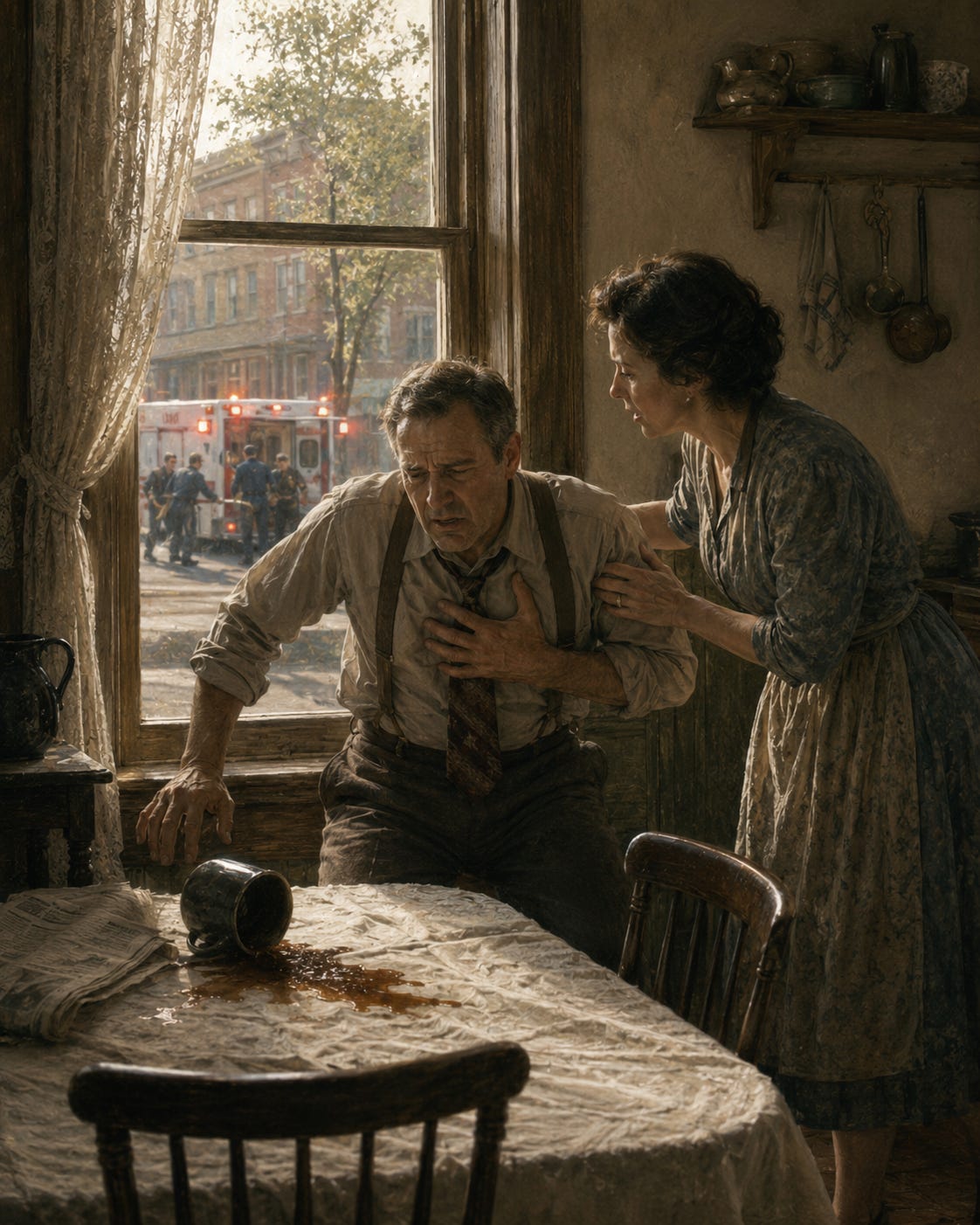
At 7:14 on a Sunday evening, Daniel Harper died at the table his mother had carried through three apartments.
Ninety-two seconds later, strangers began bringing him back.
He had been slicing roast beef when the pressure in his chest became impossible to ignore. He put down the knife, said the room felt hot, and lowered himself into the chair beside his mother. Then his eyes changed.
His daughter Lena called 911. A dispatcher told her to pull him to the floor and press hard in the center of his chest. A neighbor ran in. Sirens turned onto the street. Paramedics cut open Daniel’s shirt, placed pads against his skin, and saw the lethal rhythm moving across the monitor.
The first shock lifted his body from the floor.
The second restored a pulse.
From that moment forward, an astonishing system assembled around one failing human heart.
The ambulance transmitted an electrocardiogram before it reached the hospital. The emergency team was waiting. Blood was drawn, medicines were given, and a cardiologist met Daniel in a room built for precisely this emergency. Dye moved through his coronary arteries on a screen. One vessel narrowed to a thread and then disappeared.
A wire crossed the obstruction. A balloon opened it. A stent held it open.
By midnight, blood was flowing again.
Everything medicine did that night was extraordinary. Knowledge accumulated over generations had been converted into protocols, teams, instruments, drugs, electricity, sterile rooms, and trained judgment. Hundreds of people who would never know Daniel had contributed to the chain that saved him.
Health 2.0 could do what the system of Clara’s childhood could not: recognize a biological catastrophe in one specific person and mobilize immense capability around him.
But the catastrophe had not begun that evening.
Daniel was fifty-eight. He had worked rotating shifts at the same manufacturing plant for thirty-two years. The cafeteria served fried food through the night because that was what stayed hot. Cigarette breaks were where supervisors heard what was really happening on the line. Men who complained about pain were teased until they stopped complaining.
Daniel’s father had died young. His blood pressure had been high at two physicals. He had filled one prescription, stopped it when it made him feel tired, and intended to ask about another when work slowed down.
Work never slowed down.
Culture taught him to endure symptoms quietly and measure worth through reliability. Environment made the easiest choices the most damaging ones. Biology supplied vulnerability. His decisions were real, but they were not made in open space. They were made inside those forces, day after day, year after year.
Medicine saw almost none of that when he arrived.
It saw the artery.
The next morning, the cardiologist showed Daniel the image. On one side of the screen, the vessel ended abruptly. On the other, after treatment, it opened like a road cleared after a landslide.
‘That was the blockage,’ the physician said.
Daniel stared at the dark interruption on the first image.
‘How long was that happening?’ he asked.
‘Years,’ the physician said.
The answer unsettled him more than the procedure.
For years, his body had been recording a trajectory that no one was holding as a continuous story. The hospital could identify the precise location at which the story became an emergency. It could not reconstruct every force that had made that emergency increasingly likely.
Daniel went home with six medications, a cardiac-rehabilitation referral, dietary instructions, warning signs, appointments, and a folder thick enough to feel like a plan.
He followed much of it. He stopped smoking. He attended rehabilitation until his shift changed. He learned to read labels but still ate whatever was available at two in the morning. He became more attentive to his body, though he never stopped being the person everyone else called first when something broke.
Clara sat beside him at the old table during his first week home. She was smaller now, her hands folded around a cup of tea.
‘When I was a baby,’ she told him, ‘they changed the water.’
She touched the center of his chest, just above the bruise left by the defibrillator pad.
‘For you, they changed the artery.’
Daniel smiled. He knew she meant it as wonder, and it was wonder.
Modern medicine had returned him to his family after his heart had stopped. Few achievements in human history are more remarkable.
But his coronary artery was where the trajectory became visible.
It was not where the trajectory began.
THIS WAS HEALTH 2.0.
TREAT THE EVENT.
It brings extraordinary expertise to the individual when biological failure becomes visible—often after culture, environment, and accumulated decisions have shaped the trajectory for years.
Author’s note: The Harper family is a fictional composite created to illustrate the four eras of health. The circumstances are drawn from common patterns in public health and care delivery.