

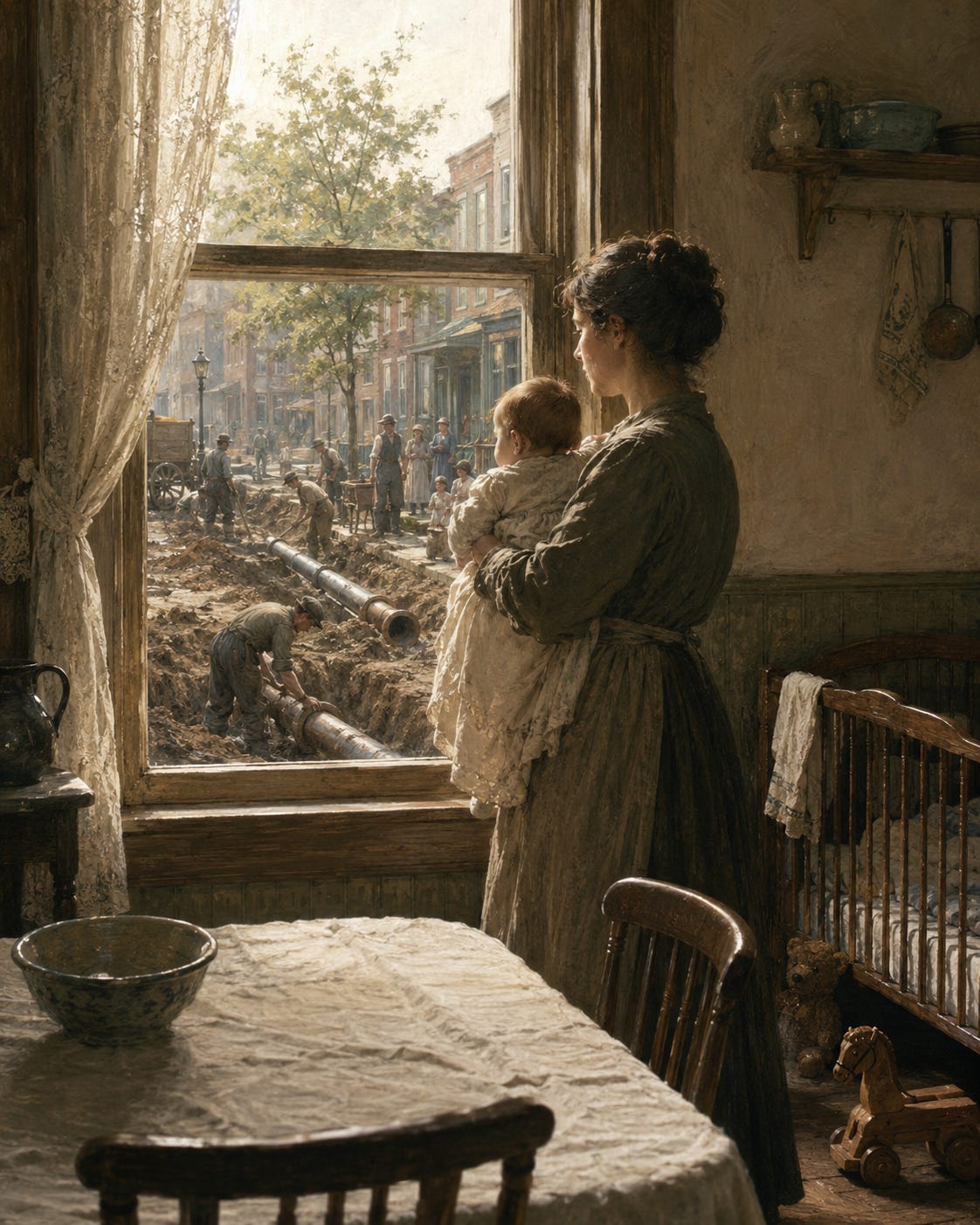
The person who saved Clara Harper’s life never entered her house. He never touched her forehead, never heard her cry, never knew that her mother had already chosen the dress in which she would be buried if the fever came.
Two summers before Clara was born, Anna Harper had lost a son.
Thomas was eleven months old when the heat settled over the city and sickness began moving from one apartment to the next. First came the vomiting. Then the fever. Then the terrible stillness of a child too weak to cry.
The physician arrived with a leather case and a grave face. He could name what was happening. He could sit beside the bed. He could not reverse the course.
By morning, Thomas was gone.
On their block, three other infants died that week. One mother blamed the milk. Another blamed the heat. Anna blamed herself. The city recorded four deaths on four separate lines.
No one yet held the whole pattern.
Then strangers began appearing near the neighborhood pump. They collected water in glass bottles. They asked where waste was emptied, where milk was stored, and which houses had lost children. An engineer placed marks on a map. A public-health nurse carried names from kitchen tables into a municipal office.
What people had been taught to endure as fate began to look like infrastructure.
The work was slow, disruptive, and largely invisible. A new main was laid beneath the street. Sewage was separated from drinking water. The supply was filtered and disinfected. Milk sellers were inspected. Refuse was collected before it could rot in the summer heat.
No one called it personalized medicine. No one asked about Clara’s genome. They changed the world immediately around her.
When Clara was born, Anna trusted almost nothing. She boiled water until the room filled with steam. She covered the milk. She washed the feeding bottle twice. Every time the baby slept too deeply, Anna placed two fingers beneath her nose.
Then the first summer passed.
Clara remained well. So did the baby upstairs, and the twins across the courtyard. The small white coffins appeared less often.
There was no dramatic rescue in Clara’s story. No ambulance came. No surgeon opened her body. No medicine pulled her back from the edge.
The edge had been moved farther away.
Clara’s susceptibility as an infant was no different from Thomas’s. What changed was the environmental force pressing upon it. Clean water made thousands of decisions before any mother had to make them.
Culture changed more slowly. Anna still believed a good mother should be able to protect her children through vigilance alone. It took years for her to understand that Thomas had not died because she failed him. The conditions surrounding them had failed them both.
Clara grew up at the same oak table where Anna had cooled boiled water in a blue enamel bowl. She did her schoolwork there. Years later, she fed her own son there. When the family moved, the table went with them, its legs shortened once, its surface scarred by hot pans and children’s pencils.
Clara lived long enough to hold a granddaughter — one who would someday ask why the family had kept such an ordinary table for so many years.
Clara never knew the name of the engineer who mapped the deaths, the nurse who carried the pattern from house to house, the workers who lowered pipe into the earth, or the official who finally agreed to fund it.
The person who saved Clara was not one person after all.
It was a public capacity: the ability to see a shared danger, change the environment, and protect people before they became patients.
A pipe beneath the street had given an entire family a future.
**THIS WAS HEALTH 1.0. PROTECT THE POPULATION.**
It acts on shared conditions—especially the environment—before the individual is known and before biology becomes disease.
*Author’s note: The Harper family is a fictional composite created to illustrate the four eras of health. The circumstances are drawn from common patterns in public health and care delivery.*