
Learn the Tell
What Diablo, World of Warcraft, and Elden Ring reveal about AI, prevention, and the American health system.

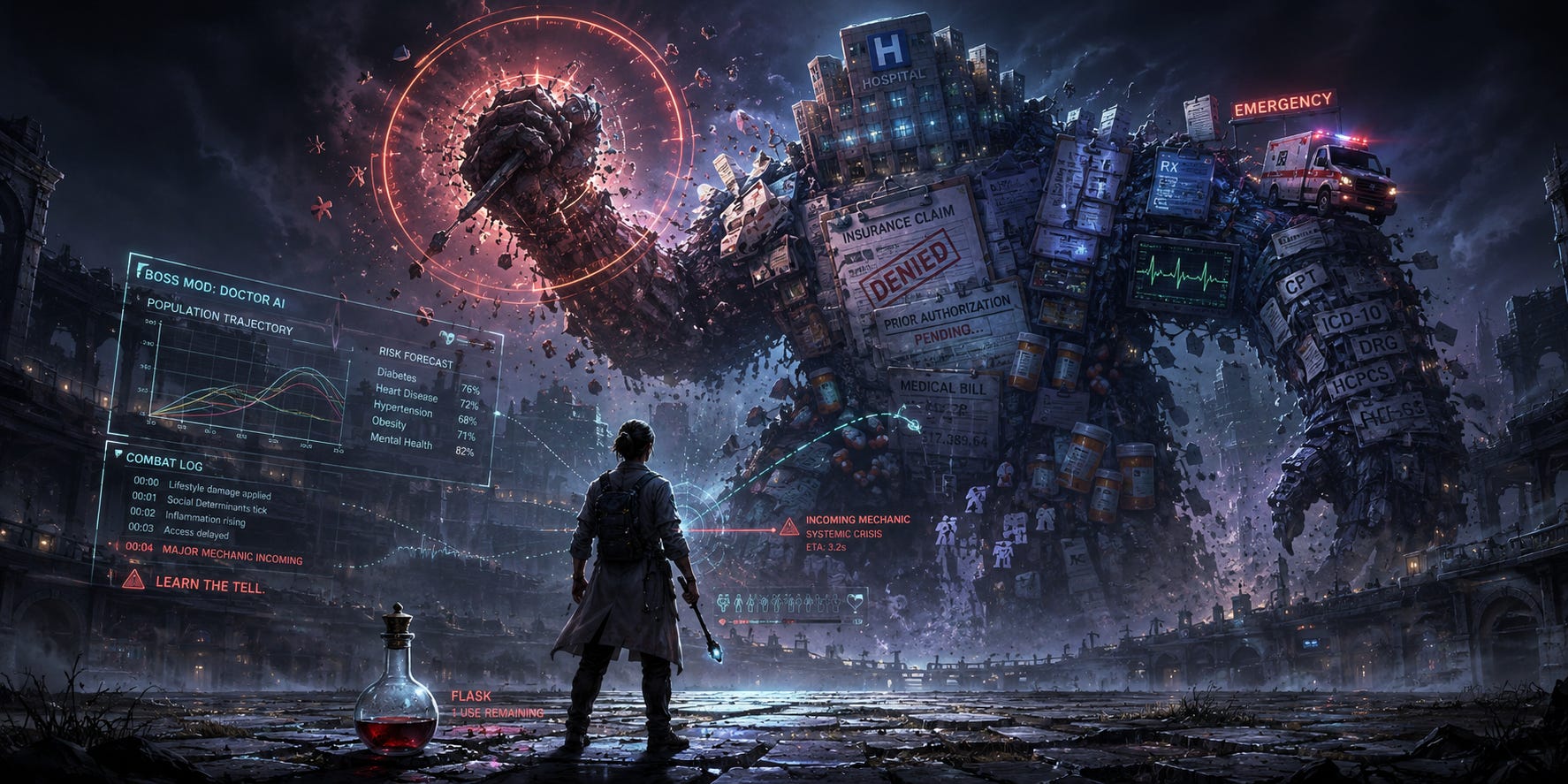
There is a version of American health care running on your PlayStation or internet right now. Several versions, actually. I’ve been playing some of them for years, and it took me an embarrassingly long time to notice that the argument I’ve spent a career making in clinics and boardrooms was sitting in my hands all along, rendered in polygons and frame rates and the specific 2 a.m. despair of a boss you cannot beat by trying harder.
I want to walk you through three games. If you’ve ever held a controller, you already understand what I’m about to say. You earned it. Nobody explained the lesson to you and nobody had to.
The world we have
Start with the one everyone knows. The loot game, Diablo. Kill things, they drop gear, the gear lets you kill bigger things faster, and when the incoming damage overwhelms you, the answer is never why is this much damage coming in. The answer is a health potion on cooldown and a better weapon. There is no prevention role. Nobody in the party is watching the trajectory. There is only the next pack of monsters, the next drop, the next season that wipes the board clean and asks you to do it again.
You can out-DPS anything if your numbers are high enough. Continuity is a fiction. The meter counts one thing: damage done.
I don’t need to draw the map. That is the health system we have. We reward the dramatic downstream intervention — the rescue, the procedure, the admission — and we pay for volume, and when chronic disease overwhelms the population we reach for more force, more intervention, more powerful gear. We built a health system that plays like a loot grinder and then we act surprised that we cannot out-DPS diabetes at scale.
The tell is that there is no role, anywhere in the design, for the person who keeps the damage from landing.
The world we could build
Now the game I mained for years. World of Warcraft. I played a Priest. More specifically, I healed — which means I learned early that survival is not about power. It is about timing, attention, and knowing the fight before the damage lands.
WoW looked like fantasy, but it behaved like American life. It was a working model of a society: people sorted into roles, resources rationed under pressure, success measured on public meters, failure blamed on the person standing closest to the damage — all while the deeper rules of the world went mostly unquestioned.
World of Warcraft even staged, by accident, one of the strangest public-health parables of the internet age: the Corrupted Blood incident. Some players tried to heal. Some warned others away. Some hid. Some spread the contagion on purpose. Designers did not set out to build a pandemic laboratory, but the world became one anyway.American health care is not a puzzle game. It is an MMO — a massive multiplayer system where every player’s choices are constrained by the rules of the world.
And inside the healer role is a quiet moral choice. You can play reactive: let the boss hit, let the raid bleed, then cast the big, beautiful, expensive heal that lands just in time. The meter lights up. The save is visible. The healer gets the credit. Or you can play prevention: shield before the pull, read the damage before it comes, spend resources early so the crisis never blooms. Prevent the wound instead of performing the rescue. In all those years I never picked the prevent option. After all, as a surgeon I was rescue incarnate.
And prevention has a public relations problem. When you do it perfectly, nothing happens. The bar does not crash. The siren does not sound. The family does not panic. The hospital bed is never filled. The death certificate is never written. No one applauds the healer for the catastrophe that never arrived.
Rescue has a scoreboard. Prevention has silence.
Here is what that game taught millions of people, years before anyone handed them the vocabulary: you cannot out-heal bad mechanics. If the tank stands in the dragon’s fire, no amount of downstream healing saves the raid. The damage is generated by the environment and the behavior. You have to change the fight, not just treat its casualties.
That is the entire argument. Prevention is a real role. It is more efficient. And our instruments cannot see it, so we do not pay for it.
The difference between WoW and the loot grinder is not better potions. It is that prevention exists as a role at all, and that the combat log makes it legible. The MMO solved a measurement problem healthcare hasn’t: it built the instrument that lets a shield show up on the record, so the person preventing the crisis is finally visible. Give me the log that proves the trajectory bent, and the question why don’t we pay for shields answers itself.
The world that is true
And then there is the third game. The strange one. The one that is haunting.
Elden Ring.
I started playing it a year or so ago, and I tried to play it the way I play everything — like a healer, reacting, topping off, managing resources against a legible threat. It refused me. It punished the reflex. And months later I am still turning it over, which is how you know a thing taught you something it never said out loud.
Three features of that game are the truest things I know about health.
The constraint is real in every move. Not the fake constraint of a cooldown that refills. The permanent kind. Every flask you drink is gone. Every choice forecloses another. The resource runs out, and the game never once pretends otherwise. You cannot rescue your way through a fight you are playing wrong — you have to change how you play, or you keep dying. American healthcare runs on the opposite fiction: infinite flasks, rescue always in stock, the cost hidden until the resource is empty and someone dies off-screen. This game puts the cost in your hand every second. It is honest in a way our system has never been.
The roles are not labeled. This is the haunting part. The one I thought about after dying yet again. In the raid, the healer is a class — assigned, legible, queued for. Here, help arrives as the summon sign of a stranger you will never speak to, a companion whose allegiance you cannot read, a spirit that fights beside you and then is gone. And harm arrives the same way — the kindly figure who betrays, the thing in the fog that turns out to be either the ally you needed or the enemy that harms you. You cannot tell in advance. Support and threat are not pre-marked. You have to be paying attention to know which is which.
It creates uncertainty deep in your subconscious. You are off balance.
That is not bad design. That is the actual condition of being a patient in a health system where the help you need arrives from unexpected quarters and vanishes uncredited because no log records it.
The feedback is merciless and it does not lie. When you fail, the screen tells you plainly. It does not hide the trajectory or launder the failure into a quality metric. You died. Now learn the tell — the wind that comes up before the blow, the pattern you could have read if you had been watching the fight instead of the health bar. Survival is not throughput. It is earliness born of attention. The players who win are not the ones who react faster. They are the ones who saw it coming and prepared to have a different outcome. They may not be right every time, but they live longer.
That is prevention arrived at through a harder truth than the raid ever taught. Because it doesn’t offer, up front, the choice to prevent. You are in the game, as you are. The results of the culture you inherited, the biology of your character, the environment. Not “intervene sooner” as a tactic. Something closer to a discipline: you attend to the fight, you learn its patterns, you spend your finite resources on not taking the hit, because you cannot afford to take the hit. If you do, you die.
Where the machine goes
Now — the part the gaming world will feel before anyone else, because you have already lived the distinction and found it good.
In every one of these worlds there is an intelligence that sees more than you can. The boss mod that calls the incoming mechanic three seconds early. The overlay that reads the raid-wide state no single human can keep in working memory. The accumulated knowledge of ten thousand prior deaths — every player who fell to this boss before you — distilled into the sense that lets you finally read the tell.
That intelligence is not the healer. It never touches the fight. You still cast. You still dodge. You still make the call and own it. What it does is expand what you can perceive and how early you can act.
The intelligence is sight.
Not hands.
This is the thing I most want the people building the future to understand, because it dissolves the fear that has made the whole AI conversation stupid. Nobody who has cleared a hard raid believes the boss mod replaced them. The callout did not take the win. It meant nobody died to a mechanic they could not see coming. The human is still the one who acts — more capable, seeing further, because the machine held the pattern that no single mind can hold.
That is the role for AI in medicine. Not the same role as the physician/human health ally. AI is the sight.
Doctor AI is the accumulated knowledge of every prior death, surfacing the tell so a human clinician can act before the damage lands — reading the population’s and the individuals trajectory, calling the wind-up, making the human health ally a better healer without ever being the healer. Accounting for the context of the individual players uniqueness.
And here is why the suspicion about AI is so backwards. The machine draws more scrutiny than human intuition not because it is more dangerous but because it is more inspectable. You can read its callout in the log. You can audit the tell it flagged. You can inspect the health trajectory it plotted and judge the outcomes, see where the deviations and “life happens” actually impact the curve of health for any individual. Contrast that to the human hunch that has run medicine for a century. It leaves no such trace. The fragmentation of records, the misrecording of diagnosis and conversation, the hoarding of data that doesn’t belong to them.
We are training our suspicion on the one participant we can actually see.
The GPUs that render these worlds, the same compute now sitting in hospital basements and research clusters, the accelerated infrastructure the gamer world knows by name — are not building a replacement clinician. Why would they want to? They are building the boss mod for chronic disease. The overlay that sees the population-wide state. The sight that lets a finite, exhausted, deeply human healer act three seconds earlier, when three seconds earlier still means finite flasks, unlabeled allies, and a fight you cannot rescue your way out of.
Disease is a formidable boss.
The turn
So here is the whole argument, and many reading this — the gamers and the developers — already own it.
We built American healthcare like a loot grinder. Drink on cooldown, swing harder, no role for prevention, a meter that counts only the damage we do. We are surprised we cannot out-DPS a chronic disease epidemic.
We could build it like a raid, where prevention is a real role and the log makes it legible, so the shield finally shows up on the record, and we pay for the wound that never opened. Many incumbent’s in the current health game, advocate for this model. They get to keep grinding as they extract their tolls.
But the truest game is the third one, and it is the one we are actually playing whether we admit it or not. Finite resources in every move. Allies and adversaries that arrive unlabeled, health and harm you have to be present enough to tell apart. A feedback loop that will not lie to you about whether you are winning. And a fight you cannot brute force, where the only path is to see sooner, spend wisely, and change how you play the long game.
People keep dying to the same boss.
Not because we lack force. Because we refuse to learn the tell.
The flask runs out.
Learn the tell.
Change the game.
This essay is part of the H4 Alliance’s work to author a new architecture for American health, one designed to bend trajectories rather than reward rescue. If it resonated, the conversation continues at the H4 Alliance — website coming soon. Author — robinblackstone.com