
When Patients Attack Their Doctors
The trust collapse in modern medicine — and why Health 4.0 is the intervention.

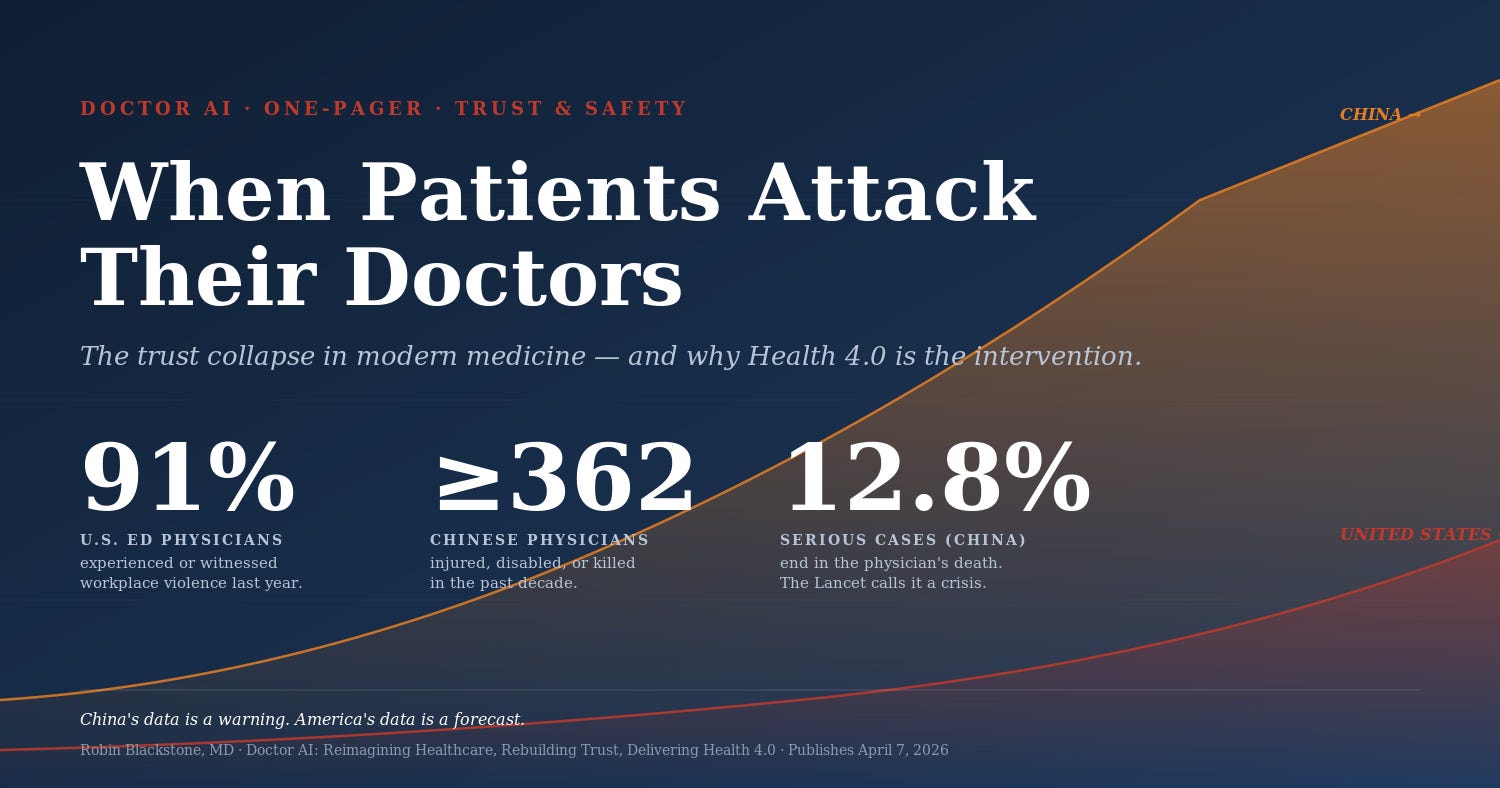
In American emergency departments this morning, a physician put on a white coat and went to work knowing — statistically — that someone in that building was going to threaten, harass, or hit them before the day was over. Ninety-one percent of emergency physicians personally experienced or witnessed workplace violence in the prior year. Reported harassment of providers more than doubled between 2018 and 2022. We have crossed a line, and very few people are willing to say it out loud.
I went looking for the comparison data, because I wanted to know how bad this gets when it gets worse. The answer is China. There, at least 362 doctors have been injured, disabled, or killed in the past decade, and in the most serious documented assault cases, 12.8% ended in the physician’s death. The Lancet has called it a crisis for the practice of medicine itself.
This is personal for me.
In 2012 I went to China, on behalf of Johnson & Johnson, to talk with the leadership in Endocrinology and Metabolic/Bariatric Surgery about establishing the data and the quality-of-care framework necessary to implement a quality system. While in Nanjing, a patient burst into our meeting and started yelling. He had come to Nanjing to have a gastric bypass to cure his diabetes and had just been told he had to go home without the surgery. The medical staff and surgeons were upset. His son came and took him out of the meeting room. The whole team spoke about his case. They had just started operating, and at a BMI of 58 with complex medical problems, he wasn’t a good place to start their experience.
All seemed calm until we left the room and he was waiting outside. He came right up to me and — through his son, who spoke English — we talked about his father’s situation. Gradually his father calmed down and began to understand. He thanked me, bowed to me, and then he and his son left.
It was a graphic demonstration of the expectations people bring to medicine, and how dangerous it can become when those expectations meet a system that cannot — or will not — explain itself. That memory was very much on my mind when the issue of violence was raised by a colleague on LinkedIn.
Two countries, one story.
Two countries, two very different health systems, one identical story underneath: when patients lose trust in the people and the institutions that are supposed to care for them, violence is what comes next. China shows the endpoint. The United States is on a slower version of the same curve.
The argument, in one sentence: physician assault is a trust problem dressed up as a security problem, and Health 4.0 — AI in service of the physician–patient relationship, not in place of it — is the most credible plan we have to reverse the curve.
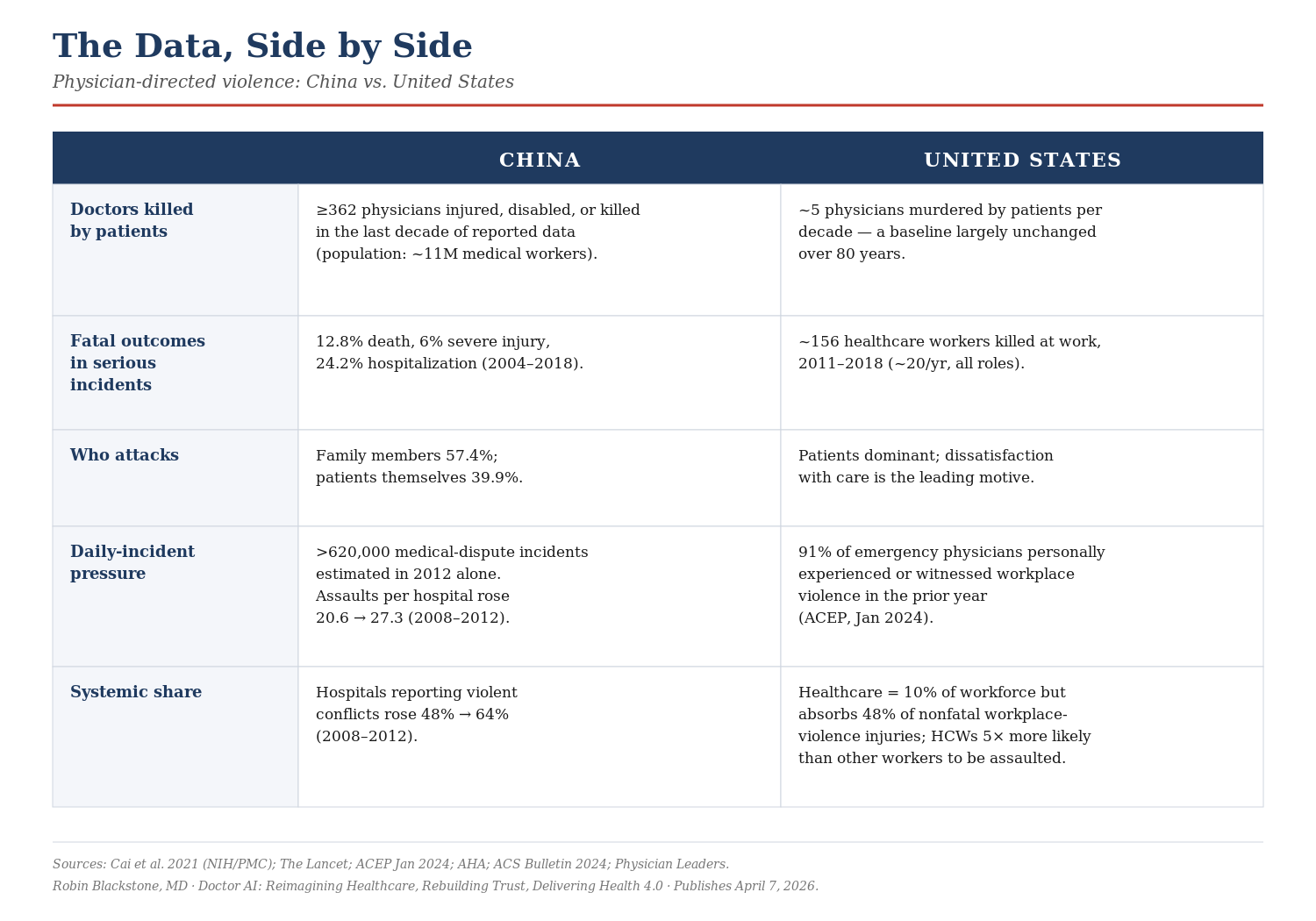
What the Numbers Are Telling Us
China shows the endpoint. When a health system becomes overstretched, opaque, and transactional, doctor–patient trust collapses — and violence becomes the symptom. The Lancet has called it a crisis for the practice of medicine itself.
The United States is on a slower version of the same curve. Murders remain rare, but the daily baseline of assault, intimidation, and harassment is now structural. Reported harassment of providers more than doubled between 2018 and 2022.
The mechanism is the same in both countries: patients who feel unseen, unheard, or wronged by a system they no longer believe is on their side. Dissatisfaction with care is the single most-cited motive in U.S. physician homicides.
Health 4.0 as the Trust Intervention
Treating physician assault as a security problem — metal detectors, panic buttons, federal felony statutes — is necessary and insufficient. It hardens the perimeter of a system whose center is failing. The opportunity, and the argument of Doctor AI, is to change what healthcare is for the patient: from a transaction they survive, to a relationship the AI-augmented physician can finally restore.
Give time back to the doctor. Ambient AI documentation, decision support, and pre-visit synthesis pull the physician out of the screen and back into the room. Eye contact is the cheapest trust-repair tool we have.
Make the system legible to the patient. Explain the diagnosis, the cost, the alternatives, and the wait — in the patient’s language, on demand. Opaque systems breed grievance. Grievance is the gateway to violence.
Surface risk before it escalates. Predictive models can flag the conditions that precede serious incidents — long waits, repeated unresolved complaints, unmanaged pain, untreated psychiatric distress — and route human attention there first.
Rebuild measurable trust. Trust is not a feeling; it is a system property. Health 4.0 lets us measure it, report on it, and hold institutions accountable to it.
The Bottom Line
Violence against doctors is the loudest possible signal that a healthcare system has lost the consent of the people it serves. China’s data is a warning. America’s data is a forecast. Doctor AI argues that Health 4.0 — AI in service of the physician–patient relationship, not in place of it — is the most credible plan we have to reverse the curve before it bends further.
Read it. Share it with anyone who runs a hospital, writes healthcare policy, or thinks the violence in our EDs is somebody else’s problem.
— Robin Blackstone, MD
Sources
Cai R. et al., Serious Workplace Violence Against Healthcare Providers in China, 2004–2018 (NIH/PMC) — https://www.ncbi.nlm.nih.gov/pmc/articles/PMC7841458/
Restoring Doctor–Patient Trust to Curb Violence Against Doctors (JMDH/PMC) — https://pmc.ncbi.nlm.nih.gov/articles/PMC9507972/
Violence against doctors in China — The Lancet — https://www.thelancet.com/journals/lancet/article/PIIS0140-6736(14)61438-0/fulltext
Council on Foreign Relations — Rising Violence Against Doctors in China — https://www.cfr.org/articles/rising-violence-against-doctors-china
American College of Surgeons — Violence Escalates Against Surgeons & Healthcare Workers (2024) — facs.org link
American Hospital Association — The Burden of Violence to U.S. Hospitals — https://www.aha.org/costsofviolence
Physician Leaders — Murders of Doctors by Patients: 123 cases since 1860 — physicianleaders.org link
ACEP — Emergency Physicians’ January 2024 Workplace Violence Poll — emergencyphysicians.org link
Stateline (Oct 2025) — Doctors and nurses are punched, attacked, even shot — stateline.org link
HIPAA Journal — SAVE Healthcare Workers Act 2025 — https://www.hipaajournal.com/save-healthcare-workers-act-2025/
Doctor AI: Reimagining Healthcare, Rebuilding Trust, Delivering Health 4.0 by Robin Blackstone, MD. (April, 2026) Amazon Books.com
American Health - Who Gets Paid by Robin Blackstone (January, 2026) Amazon Books.com
BEDSIDE A podcast by Robin Blackstone, MD - available everywhere